Published:2026-08-07
Keywords:Nano Banana Pro, Nano Banana, Nano Banana official website, comic storyboard, panel workflow, nanobanana prompts
Creators of short-drama storyboards, webcomic strips, or brand narrative ads fear “the same character changes face every panel”: panel one looks great, panel two changes the haircut, panel three drifts the outfit colors. Hiring an artist for a full storyboard is expensive, and revising one panel can take days. Trailers, social strips, and pitch PDFs end up with mismatched characters — audiences drop out at a glance.
Among the capabilities on the Nano Banana official website, Nano Banana is ideal for quickly testing camera angles and panel rhythm, while Nano Banana Pro is better at locking facial identity, outfit colors, and panel composition, so multi-panel pages feel like “one comic.” I use this workflow for creators to ship “edit-ready / pitch-ready” panel sets — from uploading a character turnaround to exporting 3–6 panels, usually in 15–25 minutes.
This is a brand-new comic storyboard & panel workflow deep-dive (different from past food menus, real-estate virtual staging, professional headshots, video thumbnails, poster infographics, or e-commerce lifestyle topics). Full prep checklist, four-step workflow, three prompt templates, character-lock tips, three case breakdowns, and a pitfalls table.
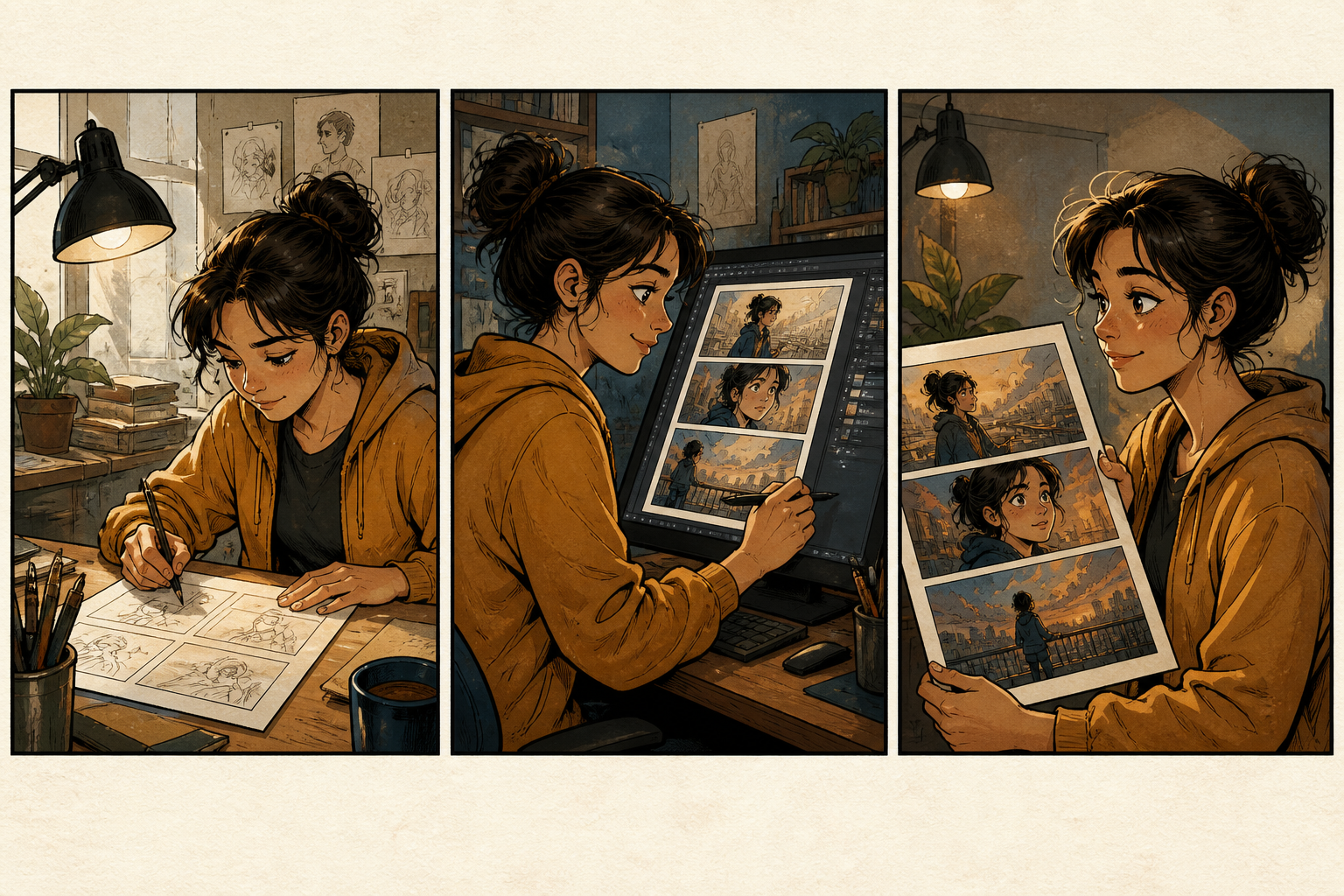
1. Why use Nano Banana / Nano Banana Pro for comic storyboards?
Nano Banana standard is ideal for “try 5 camera and mood options first”; when you need the same character stable across panels, unified aspect ratios, and usable speech-balloon negative space, switch to Nano Banana Pro:
| Capability | Hand sketch / random single frames | Nano Banana / Nano Banana Pro |
|---|---|---|
| Character consistency | Face and outfit drift every panel | Natural language lock “same character identity 100%” |
| Panel rhythm | Hard to unify shot sizes and angles | Fixed wide / medium / close-up templates |
| Style unity | Line art and color painted separately | Same ink / cel / film-comic style anchors |
| Multi-spec export | Manual crop breaks composition | 9:16 vertical strip / 16:9 pitch board / 3:4 design sheet |
| Revision speed | Redraw a whole page | “Closer panel 2, more surprised expression” conversational iterate |
The core difference: in the workflow on the Nano Banana official website, a storyboard is not “random pretty frames” — it is a reusable narrative visual asset.
2. Asset prep checklist (what decides cross-panel recognition)
Before opening Nano Banana or Nano Banana Pro, prepare:
- Character turnaround (required): Clear front or 3/4 view — hair, outfit, signature accessories complete
- Narrative beats (required): One sentence per panel (setup → conflict → reaction) — write before generating
- Style direction (required): Shonen manga, Western superhero, soft webcomic, film grayscale boards — pick only one
- Use cases: Vertical strips, landscape pitch boards, character sheets, trailer cover collages
- Platform specs: Douyin/Reels strips often 9:16; pitch PDFs often 16:9; sheets 3:4
- Negative constraints: No face swap; no outfit main-color drift; no garbled dialogue; no watermark; no merging multiple characters into one
Tip: Learn the difference between Nano Banana and Nano Banana Pro on the Nano Banana official website, then upload character turnarounds in the web app. Clearer turnarounds mean stabler cross-panel consistency.
3. Four-step workflow (turnaround → pitch-ready panels)
Step 1: Enter Nano Banana Pro and lock character identity
- Open Nano Banana web app
- Use Nano Banana to explore shots; prioritize Nano Banana Pro for final storyboards
- Upload the character turnaround; write clearly:
preserve the exact character identity, face, hair and outfit colors 100%
Step 2: Choose a panel template
Three complete prompts below:
- Template A: Vertical three-panel strip (9:16, top-to-bottom narrative)
- Template B: Landscape film storyboard grid (16:9, for pitches)
- Template C: Character sheet + expression variants (3:4, model sheet)
Step 3: Five checks before delivery
- Are three/six panels still the same character (hair, eye color, outfit main colors unchanged)?
- Do shot sizes change with the beat (not all mediums repeating)?
- Do line weight and coloring feel like one comic?
- Is there enough negative space for dialogue/titles if you overlay later?
- Any watermark, garbled text, extra fingers, or collapsed panel borders?
Step 4: Natural-language iteration + export by channel
Common instructions:
- “Keep the character unchanged; make panel 2 a close-up with a more surprised expression”
- “Unify to black-and-white ink comic style; remove color”
- “Cleaner panel borders; leave space for speech balloons”
- “Export 9:16, 4K, Nano Banana Pro”
4. Prompt Template A: Vertical three-panel strip
Replace 【】 placeholders with your content, then paste the full block into Nano Banana Pro:
Vertical comic strip storyboard, three stacked panels, 9:16.

Character lock: preserve the EXACT character from the uploaded reference — face, hair, outfit colors and signature accessories 100%. Same person in every panel.

Narrative beat:
Panel 1 (wide): 【建立场景:角色走进雨夜街道】
Panel 2 (medium): 【冲突:看到神秘信封】
Panel 3 (close-up): 【反应:表情震惊】

Style: 【日式少年漫画 / 清新条漫 / 黑白墨线】, clean panel gutters, readable silhouettes, Nano Banana Pro character consistency.

Negative constraints: no face swap between panels, no outfit recolor drift, no watermark, no garbled speech balloons unless requested, no extra characters morphing into the hero.

Output: 9:16, 4K, Nano Banana Pro comic strip.
Usage
- Upload a character turnaround
- Fill three-panel beats and style
- Shrink to phone vertical — are face and outfit still consistent?
- Iterate: “closer panel 3” / “fewer raindrops”
5. Prompt Template B: Landscape film storyboard grid
Cinematic storyboard grid, 16:9, six panels in 2x3 layout for pitch PDF.

Identity: keep the same hero character as reference 100% across all panels (Nano Banana Pro recommended for face lock).

Shots:
1 wide establishing 【城市天台黄昏】
2 medium dialogue 【两人对话】
3 over-shoulder 【看向远方】
4 action medium 【追赶】
5 extreme close-up eyes 【决心】
6 wide resolve 【并肩站立】

Look: film storyboard grayscale or limited color, clear camera angles, production-ready framing for 【短剧预告 / 广告提案】.

Lighting: consistent key direction across panels; soft rim optional.

Negative constraints: no panel border collapse, no identity drift, no watermark, no unreadable tiny text baked in.

Output: 16:9, high resolution, Nano Banana or Nano Banana Pro storyboard.
For pitch decks, “clear shot-size changes” matter more than “one ultra-pretty panel”; clients need to read narrative rhythm.
6. Prompt Template C: Character sheet & expression variants
Character design sheet page, 3:4 portrait.

Hero: preserve identity from reference 100%; main full-body or 3/4 view centered LEFT; on the RIGHT show three expression variants (neutral / smile / shock) as smaller busts.

Style: clean 【漫画设定集 / 动画 model sheet】 look, labeled gutters optional but keep text areas empty for later, Nano Banana Pro consistency.

Background: soft paper or flat studio gray; no busy scenery stealing focus.

Negative constraints: no different haircut across busts, no costume color drift, no watermark, no melted hands.

Output: 3:4, 4K, Nano Banana Pro.
Sheets and strip panels share the same character-identity library — the longer the series runs, the more time you save.
7. Character lock & panel tips (comic-specific)
In Nano Banana / Nano Banana Pro prompts, lock these rules:
- Open with character lock:
preserve exact character identity 100% - Change one class per round: Do not heavily alter shot size + expression + background together
- One sentence beat per panel: Write setup / conflict / reaction into panel descriptions
- Series anchors: Fix one ink style and palette for the whole episode
- Vertical silhouette first: On 9:16 strips, make the character outline readable on small screens
- Reject face swap: Write
same face across panels, no identity drift
Append these as “Comic rules: …” at the end of your prompt — panel series stay much more stable.
8. Three real case breakdowns
Case 1: Short-drama trailer — text beats to pitch storyboard
- Goal: Director had only written beats; no artist availability
- Flow: Template B + character turnaround + six-shot list
- Result: Nano Banana Pro delivered a PDF-ready 16:9 grid in one pass
Case 2: Webcomic strip panel 2 “face swap”
- Goal: Hair and eye color drifted in panel 2
- Flow: Template A — strengthen preserve face/hair/outfit; change only expression and shot size
- Result: Three panels read as the same lead; reading flow intact
Case 3: Brand IP sheet unified with social strips
- Goal: Model sheet and strip did not look like the same character
- Flow: Same reference through Templates C + A with shared identity lock
- Result: Brand visuals consistent; still recognizable as that IP
9. Common mistakes & how to avoid them
| Common mistake | Why it fails | How Nano Banana avoids it |
|---|---|---|
| Prompt only says “draw a comic” | Random new character each panel | Explicitly preserve character identity 100% |
| Too much plot in one panel | Crowded, unreadable | One event per panel; three panels finish one beat |
| All medium shots repeating | No narrative rhythm | Force wide / medium / close-up |
| Outfit color changes every panel | Looks like different people | Fix outfit colors in the lock sentence |
| Bake dialogue into the image | Garbled text hard to edit | Leave negative space; overlay text later |
| Finalize pitch on standard | Faces drift across panels | Finalize on Nano Banana Pro |
10. Nano Banana vs Nano Banana Pro — which to pick
| Scenario | Recommended | Why |
|---|---|---|
| Try 5 shots / moods | Nano Banana | Fast exploration |
| Pitch storyboard final | Nano Banana Pro | Cross-panel faces more stable |
| Vertical strip series | Nano Banana Pro | Small-screen consistency matters more |
| Character design sheet | Nano Banana Pro | Expression variants without face swap |
| Daily draft brainstorm | Nano Banana | Direction first, then Pro polish |
11. Quick start in three steps
- Open Nano Banana official website to learn the product, enter the web app, and upload a clear character turnaround
- Copy Template A or B, fill beats and style, stress
preserve exact character identity 100% - Iterate with short instructions, then export 9:16 / 16:9 / 3:4 strip, storyboard, and sheet sets
12. Closing thought
The essence of comic storyboarding is not “every panel pretty alone” — it is letting readers recognize the same person across frames and follow the narrative beat. Explore cameras with Nano Banana, lock character and panels and export by channel with Nano Banana Pro, and on the Nano Banana official website in one workflow you can turn written beats into publishable, pitch-ready storyboard assets.